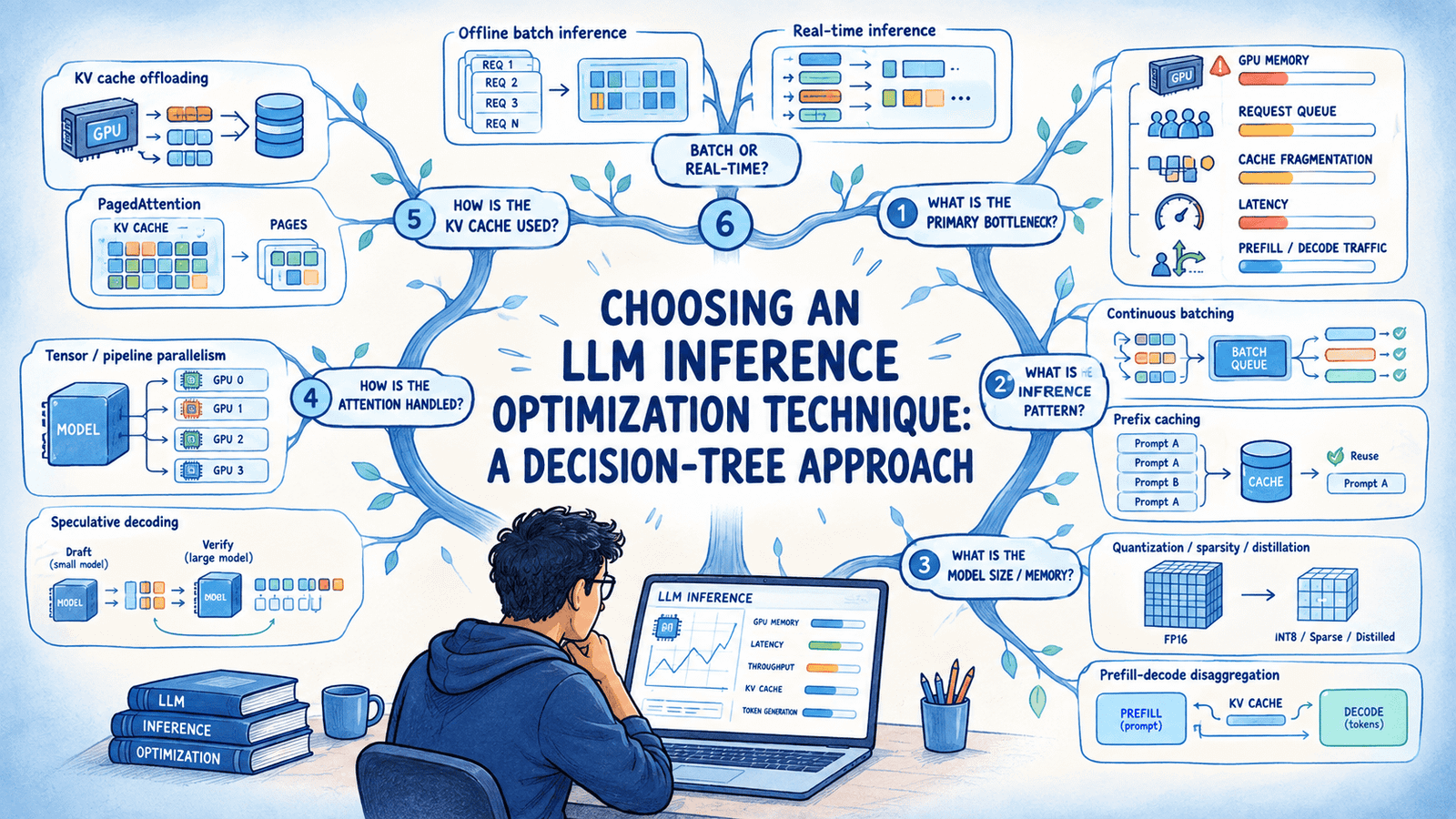

On this article, you’ll discover ways to match an LLM inference optimization method to the precise bottleneck in your workload by working by way of a six-question resolution tree.
Subjects we are going to cowl embrace:
- What every main inference optimization method, from quantization to prefill-decode disaggregation, assumes about your workload.
- Easy methods to work by way of a call tree that routes you to the proper method primarily based in your mannequin and site visitors.
- How the strategies evaluate on trade-offs, and which signs present {that a} chosen method isn’t working.
Introduction
LLM inference will get sluggish and costly as site visitors grows. Requests queue behind lengthy generations, GPU reminiscence fills with cached consideration state, and the {hardware} spends a lot of its time ready on reminiscence reads.
Inference optimization is the set of strategies that assist right here. Some strategies goal reminiscence, some goal compute, and a few goal how requests are scheduled in opposition to one another. Every method assumes one thing particular about your workload, so the proper alternative will depend on which assumptions maintain for yours. This text covers:
- What every main inference optimization method assumes about your workload
- A call tree that routes you to a way
- How the strategies evaluate on latency, throughput, and implementation value
- The signs that present a way isn’t working
We begin with what every method assumes.
What Every Inference Optimization Approach Assumes
LLM inference has many optimization strategies, however each addresses a distinct kind of bottleneck. Earlier than utilizing one, it helps to grasp the workload it’s designed for.
| Approach | What It Assumes |
|---|---|
| Quantization / sparsity / distillation | The mannequin itself is simply too giant for the {hardware} or the latency funds, and shrinking it’s price some accuracy danger |
| Prefix caching | Many requests share an similar beginning sequence of tokens, so recomputing that prefix is wasted work |
| Steady (in-flight) batching | Requests arrive concurrently with unpredictable output lengths, and ready for the slowest one in a batch wastes the GPU |
| PagedAttention | KV cache reminiscence is fragmented or over-provisioned, capping batch measurement beneath what the {hardware} might in any other case maintain |
| Speculative decoding | Decode is the bottleneck, tokens are generated one by one, and a less expensive draft mannequin can guess a number of of them appropriately |
| Prefill-decode disaggregation | Prefill and decode are contending for a similar GPU, and that rivalry is hurting each time-to-first-token and inter-token latency directly |
| Tensor / pipeline parallelism | The mannequin doesn’t slot in a single machine’s reminiscence, or per-device compute is the ceiling on throughput |
| KV cache offloading | Helpful cache entries are being evicted too early as a result of GPU reminiscence can’t maintain all the things you’d prefer to hold |
| Offline batch inference | Requests don’t want an interactive response, and whole throughput outweighs per-request latency |
Select the method primarily based on the bottleneck in your workload to keep away from pointless complexity.
Working By way of a Determination Tree to Select a Approach
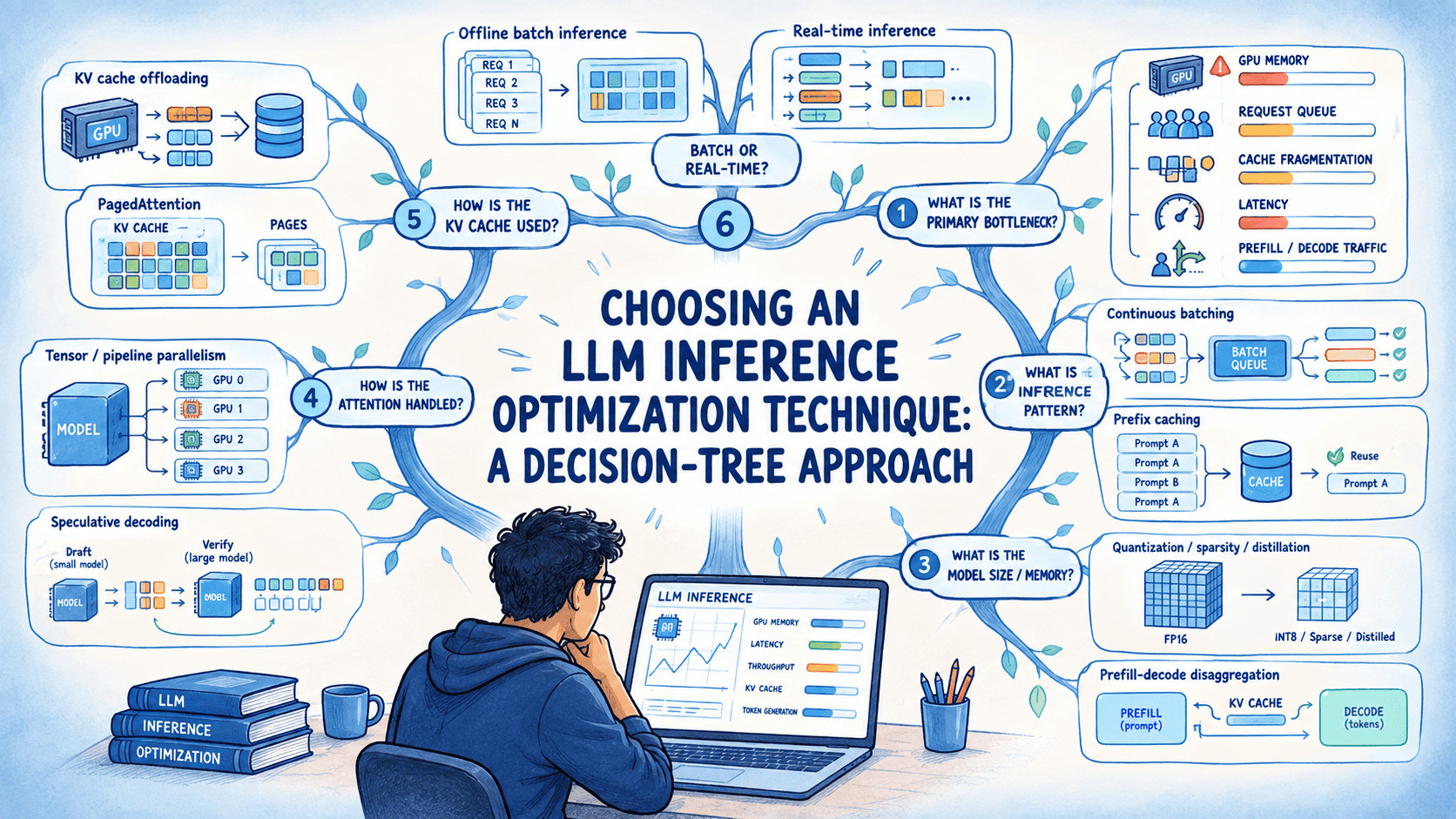
The tree beneath has six branching questions. Every one narrows the sphere primarily based on a selected property of your mannequin or your site visitors. Each query ends the identical means: a direct reply if the situation holds, and a pointer to the following query if it doesn’t.
Query 1: Does the Mannequin Match Comfortably on Your Goal {Hardware}?
Earlier than transferring on to the serving stack, test whether or not the mannequin itself is the issue. A mannequin that hardly suits in GPU reminiscence leaves virtually no room for KV cache, which caps your batch measurement regardless of how good your scheduler is.
If the mannequin is simply too giant, or inference is compute-bound even at batch measurement one, begin with model-level compression:
- Quantization reduces the precision of weights and activations.
- Structured sparsity removes much less essential weights to cut back computation.
- Distillation trains a smaller mannequin to imitate a bigger mannequin.
These strategies are largely impartial of the serving stack, and you could need to contemplate them first as a result of they decide how a lot {hardware} capability stays.
If the mannequin already suits with headroom to spare, transfer to Query 2.
Query 2: Do Your Requests Share Repeated Immediate Construction?
Chat purposes resend the complete dialog historical past on each flip. Agent frameworks reuse the identical system immediate throughout 1000’s of calls. Retrieval-augmented era (RAG) pipelines usually prepend the identical directions to completely different retrieved contexts.
If a significant share of your site visitors has an similar prefix, whether or not that’s a system immediate or a rising chat historical past, prefix caching is the highest-leverage method accessible. It skips recomputing the KV cache for tokens the mannequin has already processed, and the positive factors compound as conversations get longer.
⚠️ Prefix caching solely works when the shared prefix matches precisely, character for character. Put steady, reusable content material first and variable content material on the finish of the immediate.
In case your prompts are largely distinctive with little shared construction, transfer to Query 3.
Query 3: Are Requests Arriving Concurrently With Variable Output Lengths?
A help chatbot that returns a one-sentence reply and a code assistant that returns 4 hundred traces hardly ever end on the similar time, even when they began collectively. Beneath naive batching, the entire batch waits on the slowest request.
In case your site visitors mixes brief and lengthy generations and arrives in overlapping bursts, steady batching fixes the idle time this creates. Completed sequences depart the batch instantly, permitting new requests to begin with out ready for a batch boundary. Most serving engines allow this by default.
In case your site visitors is already well-batched and GPU idle time shouldn’t be an issue, transfer to Query 4.
Query 4: Is KV Cache Fragmentation Limiting Your Batch Measurement?
Some engines reserve a hard and fast, contiguous block of reminiscence per request sized for the utmost doable sequence size, even when most requests are a lot shorter. That reserved house sits unused for the lifetime of the request and blocks different requests from utilizing it.
If KV cache is losing reminiscence or limiting batch measurement, PagedAttention might help. It splits the cache into fixed-size pages, permitting reminiscence to be allotted in smaller chunks as an alternative of enormous contiguous blocks. Most fashionable serving engines already help it, so test whether or not it’s enabled earlier than including new configuration.
If reminiscence shouldn’t be the constraint, transfer to Query 5.
Query 5: Is Per-Token Decode Latency the Metric You’re Focusing On?
In case your aim is quicker token streaming for every consumer slightly than increased general throughput, contemplate speculative decoding.
A smaller draft mannequin predicts a number of tokens forward, and the primary mannequin verifies them in a single cross. When the draft mannequin predicts appropriately, a number of sequential decode steps might be accomplished collectively, lowering inter-token latency.
The trade-off is the additional mannequin and verification overhead. When you don’t have an acceptable draft mannequin or its predictions are accepted too hardly ever, the added complexity could not repay. In that case, transfer to Query 6.
Query 6: Are Prefill and Decode Contending for the Similar GPU at Scale?
That is primarily a production-scale concern as a result of it modifications the serving structure.
If lengthy prefills are delaying decode requests and hurting each time-to-first-token and inter-token latency, prefill-decode disaggregation can separate the 2 phases onto devoted {hardware}. Prefill nodes course of prompts, then cross the KV cache to decode nodes optimized for token era.
This provides KV-cache switch and routing overhead, so it is smart solely when the site visitors justifies that complexity. For smaller workloads or non-interactive requests, offline batch inference is commonly easier. If none of those circumstances apply, begin with steady batching and prefix caching.
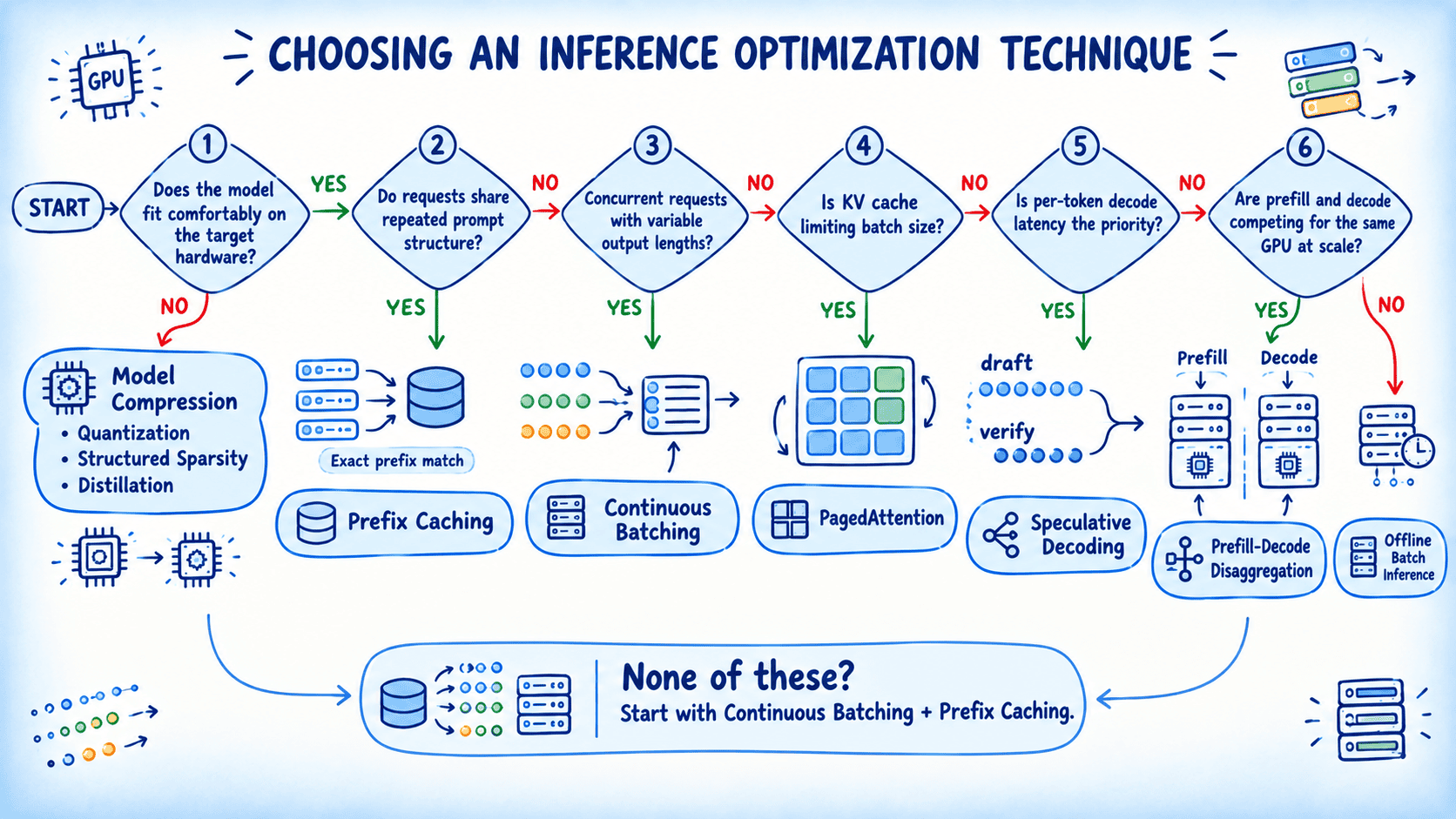
Mapping the Determination Tree to an Optimization Approach
Working by way of the tree lands you on one of many strategies within the following desk:
| Approach | Finest For | Commerce-off |
|---|---|---|
| Quantization / sparsity / distillation | Fashions too giant for the goal {hardware} or latency funds | Some accuracy loss, and quantized activations are more durable to get proper than quantized weights |
| Prefix caching | Chat, brokers, and RAG workloads with repeated immediate construction | Breaks on any character-level mismatch within the shared prefix |
| Steady batching | Concurrent site visitors with variable output lengths | Minimal draw back; largely a matter of whether or not it’s enabled |
| PagedAttention | Workloads bottlenecked by KV cache fragmentation | Provides a web page desk layer to consideration computation |
| Speculative decoding | Latency-sensitive single-user era | Wants a draft mannequin with a fairly excessive acceptance charge to repay |
| Prefill-decode disaggregation | Giant-scale site visitors the place prefill and decode contend for a similar GPU | Community value of transferring the KV cache between nodes, plus routing complexity |
| Tensor / pipeline parallelism | Fashions that don’t match on a single machine | Pipeline bubbles and inter-device communication overhead |
| KV cache offloading | Lengthy-context or high-concurrency workloads operating out of GPU reminiscence for cache | Fetching offloaded cache again provides latency |
| Offline batch inference | Non-interactive workloads prioritizing whole throughput | Not usable for something with a strict response-time requirement |
Recognizing Widespread Inference Optimization Pitfalls
A way that you just suppose will work could behave fairly in a different way in observe. The indicators beneath let you know when that’s occurring and what to test first.
| Symptom | Doubtless Trigger | Repair |
|---|---|---|
| Prefix cache hit charge is close to zero regardless of repeated prompts | Non-deterministic serialization, or dynamic content material positioned early within the immediate | Entrance-load static content material and repair key ordering in serialized context |
| Batch measurement gained’t develop even with reminiscence to spare | PagedAttention isn’t enabled, or web page measurement is misconfigured | Examine the serving engine’s batching and cache flags straight slightly than assuming defaults |
| Speculative decoding is slower than plain decoding | Draft mannequin’s acceptance charge is simply too low for the goal mannequin | Decide a draft mannequin nearer in conduct to the goal, or drop speculative decoding for this workload |
| Disaggregation made latency worse, not higher | Workload is simply too small, or most requests are brief and cache-heavy | Fall again to native prefill and revisit disaggregation solely previous an outlined site visitors threshold |
| Throughput positive factors from quantization didn’t present up | Solely weights have been quantized whereas activations stayed at full precision, and the GPU nonetheless converts again earlier than compute | Profile the place time is spent earlier than assuming quantization alone will repair throughput |
If a way constantly underperforms, test its underlying assumption earlier than including extra complexity.
Wrapping Up
Selecting an inference optimization method begins with figuring out your bottleneck. Mannequin measurement, immediate overlap, site visitors concurrency, reminiscence fragmentation, and the steadiness between throughput and per-user latency every level towards a distinct reply, and most programs will want a mix of some of those slightly than counting on only one.
When you’re desirous about studying extra, you could discover The Roadmap to Mastering LLM Inference Optimization helpful.
Comfortable studying!

About Bala Priya C
Bala Priya is a developer, educator, and technical author primarily based in India. She writes about programming, knowledge science, machine studying, and AI, with a give attention to making advanced technical concepts sensible and approachable.
With over 5 years of expertise in technical writing, she creates tutorials, how-to guides, and deep dives that assist builders construct, clear up issues, and perceive advanced technical ideas. Her technical pursuits embrace LLM purposes, agentic AI, graph algorithms, pc imaginative and prescient, explainable AI, and ML programs.
When she’s not writing or coding, Bala is normally studying traditional literature, epic fantasy, or speculative fiction. She additionally enjoys speaking about books, studying new issues, and sharing what she learns with the developer group.