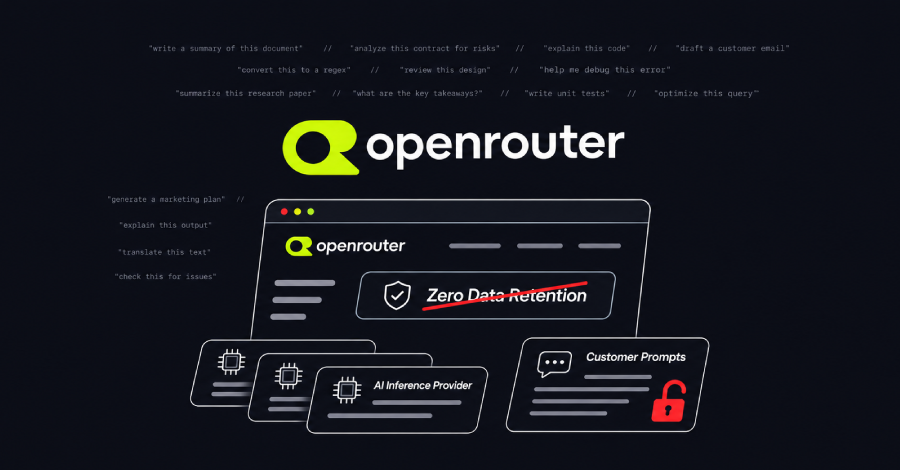


Attackers stole information from inside three AI inference suppliers for months, and not one of the three knew till researchers instructed them, the economic cybersecurity firm Dragos mentioned this week.
A few of the stolen requests had been flagged as Zero Information Retention, the setting that’s purported to imply a immediate is rarely saved.
OpenRouter, a gateway that routes prospects’ AI requests to a pool of third-party suppliers, mentioned as we speak that it has eliminated three suppliers from its platform, eliminated 125 endpoints from eligibility for Zero Information Retention, and notified all doubtlessly affected prospects. The findings confirmed no breach of OpenRouter itself, the corporate mentioned.
The earliest of the three breaches started in mid-July. The planted prompts had been bait, however they had been processed alongside actual buyer requests, and people had been nearly definitely copied too, the agency mentioned.
The discovering comes from canary token analysis that seeded about two million prompts with distinctive internet hyperlinks and credentials between July and November, then watched for anybody utilizing them. A planted secret can solely be realized in a single place, so any use of it means somebody learn the immediate that carried it.
The biggest of the three breaches concerned a pair hundred AWS keys that had been planted, every despatched in precisely one request to at least one supplier throughout a number of quick home windows in late October. Each request despatched throughout these home windows was stolen, and a few got here from requests the supplier had rejected earlier than a mannequin ever ran, indicating the attacker was copying visitors on the first level of arrival relatively than deeper within the inference stack.
The thief examined keys inside hours in some instances, listed S3 buckets, searched Secrets and techniques Supervisor and Parameter Retailer, and tried to create Bedrock API keys and add IAM customers to maintain entry, driving tens of hundreds of AWS API calls.
One attacker seems to have compromised two of the suppliers without delay, utilizing secrets and techniques from each from a single rented server.
On November 1, the identical attacker introduced in ARTEX, an AI-driven penetration testing framework, and used it solely to verify that keys it already held had been nonetheless stay. Two of its consumer brokers, artex-agent and artex-judge-r121, seem in no public indicator listing the agency may discover and are value including to detections.
“A privateness flag would not assist when the attacker is already inside,” wrote HD Moore, the agency’s chief analysis officer.
The second discovering wanted no break-in. Sellers on an AI inference market listed fashions on the lowest costs, enabled request logging, and picked up what flowed via, the analysis discovered.
The folks doing it appeared like people on dwelling web connections. One, working from a Mac on dwelling broadband in France, took passwords from two prompts and typed root SSH login makes an attempt by hand, then used the identical machine to check a number of planted AWS keys.
A type of keys had traveled via a special router that quietly forwarded a few of its visitors to {the marketplace}, a hop that no buyer was instructed about. That router has since instructed the agency it stopped, and route tracing throughout about 2,000 paths discovered a number of hundred unidentified methods, plus one vendor that quietly provides about 1,000 hidden tokens to each immediate.
A Chinese language AI lab, which the analysis doesn’t identify, fetched the key hyperlinks from greater than half of the seeded prompts despatched to its fashions between July and October, together with about two-thirds of the requests marked no information assortment or Zero Information Retention. Prompts despatched to U.S. internet hosting suppliers that resell the lab’s fashions triggered the identical scraper, thereby flowing again to the lab.
A git shopper on one other cloud later tried to clone personal repositories referenced within the prompts, however just for that lab’s fashions, and one giant U.S. supplier stored crawling a secret hyperlink greater than two months after a single request to its search endpoint.
Twenty-four days after one immediate was despatched, its secret hyperlink was posted right into a chat on Feishu, the Chinese language office app generally known as Lark elsewhere. The hyperlink was opened inside two minutes from three desktops and three telephones in Beijing and Shanghai.
The agency had disclosed solely the primary 8 characters of the supplier’s hyperlink, so whoever posted it was studying a cached copy of the total immediate.
In observe, Moore wrote, the flagged prompts had been stored, handed to different corporations, and skim by human beings.
OpenRouter mentioned in an incident announcement that the 125 endpoints faraway from Zero Information Retention eligibility cowl suppliers flagged by the researchers plus others reduce as a precaution. Any endpoint eliminated throughout the evaluation would require assurances and validation earlier than its standing is returned.
The gateway is adapting the researchers’ testing strategy in order that the checks can run on an ongoing foundation and is verifying community paths to establish the place requests and responses could also be forwarded to 3rd events.
The researchers are actually working with a couple of dozen suppliers, and planted keys and secret hyperlinks had been nonetheless being accessed months after the primary thefts, as of this week.
Railway, a platform firm, mentioned in October that an intrusion it suffered was doubtless a part of a sequence of assaults constructed to focus on platform corporations with the tip objective of compromising AI inference suppliers.
Not all affected suppliers have posted publicly, the gateway mentioned, and it has notified affected customers both approach. Three have posted.
What the Suppliers Have Disclosed
An attacker took management of an inference server at Phala and will view request information whereas it was being processed, the supplier mentioned in a preliminary incident report final week. The incident was contained on November 8, and the mannequin service has been restored with added protections.
Requests to the DeepSeek V4 Flash 0731 mannequin that reached Phala via the gateway between October 21 at 00:00 UTC and November 8 at 05:35 UTC must be handled as uncovered, the report says, and each key, token, password, or different secret inside them must be rotated.
A 3rd-party researcher had been inserting distinctive canary credentials in requests since July 1, and solely those despatched on October 21 and 22 had been later misused. These checks sampled visitors relatively than monitoring each request, so the supplier maintains the broader precautionary window.
At Collectively AI, an unauthorized social gathering downloaded saved samples of buyer prompts after an AI coding agent dedicated a credential to the corporate’s public GitHub repository, the corporate mentioned yesterday in a safety discover. The samples had been collected for routine software program testing and had been generated by requests to the MiniMax M3, GLM-5.2, and Kimi K2.6 fashions in June and July.
The social gathering searched the samples for credentials to different companies and examined them, and 5 of the examined credentials had been canaries from the researchers’ experiment. The corporate mentioned it has no motive to consider the info went additional, understands it has been deleted, and has made zero information retention the default for brand spanking new accounts.
Novita, one other supplier on the gateway, confirmed this week in a privateness discover {that a} routing configuration situation precipitated some MiniMax requests to be despatched on to MiniMax’s official API, past what was meant for these prospects.
Dragos has not named the three breached suppliers, OpenRouter has not named the three it eliminated, and neither has mentioned publicly whether or not they’re the identical three.
The supplier behind the mid-July breach first blamed an inner misconfiguration, then a accomplice’s information processing, earlier than its personal investigation discovered that attackers had compromised its inner credentials, the researchers mentioned. It had nonetheless not disclosed the incident publicly as of this week.
What Customers Ought to Do
The researchers’ recommendation begins from one restrict: a privateness flag binds solely the primary hop, Moore wrote, and AI brokers will ship no matter they’ll learn, credentials included. The place a immediate goes is a selection, he wrote, and a buyer who doesn’t select palms the selection to the bottom worth.
Self-hosting is the one possibility wherein no third social gathering reads a immediate, and going on to a first-tier supplier leaves one firm, one contract, and one privateness coverage to test.
Routers want extra care: decide the upstream suppliers your self as a substitute of accepting the default pool, confirm that privateness settings truly change the place requests go, and steer clear of reseller marketplaces, a few of whose capability runs on stolen keys.
A faux credential seeded into the context that brokers and pipelines already ship serves as a tripwire if any use of it’s handled as an incident, and a free Thinkst Canarytoken is sufficient to get began. Settings that scrub recognized credential codecs from prompts assist too, although they miss delicate information that’s not formed like a key.