

The risk actors behind the PolinRider marketing campaign have been noticed planting a Python loader in GitHub repositories, as proof emerges that the exercise might have began way back to February 2025.
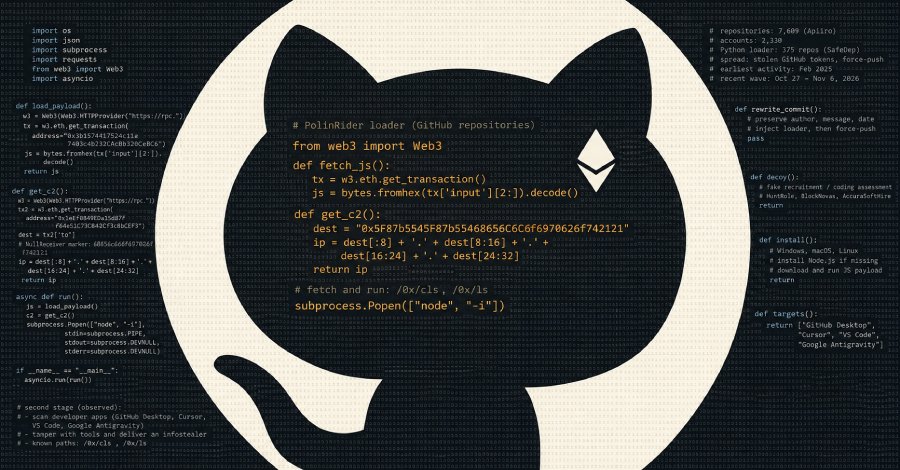
“The loader hides in a small utils bundle or in conftest.py,” SafeDep mentioned in a report printed this week. “When Python imports the file, the loader reads the latest transaction that an Ethereum pockets despatched to itself. It decodes the enter information of that transaction as JavaScript and runs it with Node.js.”
The JavaScript code, for its half, reads a second pockets to find the command-and-control (C2) server after which passes the following stage to a indifferent interactive Node.js setting by the use of a node -i course of.
The software program provide chain safety firm mentioned it recognized the loader in 375 public repositories that belong to 260 accounts. There isn’t any proof that the loader has been distributed through PyPI or npm.
PolinRider is the identify assigned to a malicious marketing campaign linked to North Korean risk actors. Current studies point out that the exercise employs varied channels to distribute malware, together with –
- Fraudulent recruitment campaigns that make use of phishing emails and pretend hiring portals like BlockNovas, AccuraSoftHire (“accurasofthire[.]com”) and HuntRole (“huntrole[.]org”) to trick potential targets into working malware-laced tasks underneath the pretext of a take-home evaluation.
- Publishing malicious packages throughout open-source ecosystems by hijacking maintainer accounts to plant obfuscated malware by means of pretend font recordsdata (fa-solid-400.woff2, fa-solid-500.woff2, or fa-solid-300.llf), Visible Studio Code (VS Code) auto-run duties, and Git historical past rewriting.
- Utilizing compromised developer machines to steal their GitHub tokens and force-push malicious commits into open-source repositories they’ve entry to.
At a excessive stage, the PolinRider loader retrieves an encrypted second-stage Node.js payload that scans the contaminated host for put in developer purposes, similar to GitHub Desktop, Cursor, VS Code, and Google Antigravity, and tampers with essentially the most often used instruments to execute attacker-controlled code and ship infostealer malware.
It is price noting right here that PolinRider is assessed to be a sub-cluster working in parallel with a long-running marketing campaign codenamed Contagious Interview. Whereas the latter is extra of a social-engineering entry level that is used to compromise developer techniques, PolinRider abuses the entry to change repositories and switch them right into a distribution channel for malware.

“Cybercriminal teams deploy provide chain worms for opportunistic theft. Alternatively, North Korean state-sponsored risk actors use open-source software program registries as a main preliminary entry vector concentrating on company environments,” Palo Alto Networks Unit 42 mentioned in a report printed final month.
“Menace actors show how compromising a single maintainer account or registry scope converts open-source dependencies, leading to widespread affected cloud environments.”
A few of the decoy websites have been discovered to include two different alternate supply paths –
- Instruct candidates to sideload a Google Chrome extension after enabling “Developer mode” to subscribe to new job alerts.
- Make use of ClickFix-style lures to get victims to repeat and paste malicious instructions into the terminal app relying on the working system as a part of a “commonplace settings bundle for candidates and interview workflows.”
“The [job] software asks for a brief verification video,” StepSecurity mentioned. “Till the server marks a candidate as having put in a ‘driver,’ the digicam test all the time fails with a message saying the system doesn’t have a appropriate digicam setting.”
“A separate ‘Technical onboarding’ web page on the positioning offers a one-line curl command to obtain the ‘driver.’ On Home windows, the downloaded installer fetches a script from the careers website that installs Node.js whether it is lacking, downloads a JavaScript payload, runs it within the background and deletes itself. The macOS and Linux variations do the identical.”
The JavaScript malware is designed to carry out the next steps –
- Learn the newest transaction related to an Ethereum pockets (“0xa322E5f3D311D3080e6f0121063e9aDC2490Ef1a”).
- Get its vacation spot pockets tackle (“0x67B38e9b67B38E9b68656c6C6f6970626f742121”).
- Extract the C2 server tackle twice (“103.179.142[.]155”) from the primary eight bytes (“67B38e9b” and “67B38E9b”) of the pockets tackle, utilizing a method known as NullReceiver, whereas the final 12 bytes signify the ASCII string “helloipbot!!.”
- Use the IP tackle to fetch two payloads, “0x/cls” and “0x/ls,” over port 443.
 |
| The NullReceiver method |
The most recent findings from SafeDep present that the repositories are injected with a 58-line Python loader that reads the “0x3b1574417524c11a7403c4b232CAcBb320CceBC6” pockets to extract JavaScript code that then reaches out to a second pockets (“0x1eEf0849EDa15d87f64e51C73C8442Cf3c8bCEF3”) to acquire the vacation spot pockets related to the newest transaction (“0x5F87b5545F87b55468656C6C6f6970626f742121”), which is then used to parse the C2 server (“95.135.181[.]84”).
A defining facet of NullReceiver is the marker “68656c6C6f6970626f742121” within the made-up vacation spot pockets tackle that constantly interprets to “helloipbot!!.”
“The /0x/cls script runs twice, as soon as with eval within the present course of and as soon as in a brand new course of,” SafeDep mentioned. “The /0x/ls script runs solely in a brand new course of.”
The precise nature of those payloads stays unknown. Nonetheless, prior waves have been noticed putting in a stealer that harvests setting secrets and techniques, browser passwords, cookies, and pockets information. Apparently, the pockets tackle “0x1eef0849eda15d87f64e51c73c8442cf3c8bcef3” has been reused by the risk actors throughout different assault waves –
- Pushing compromised variations of authentic npm packages similar to @adminide-stack/utils, @adminide-stack/health-api-server, @adminide-stack/user-activity-browser, @adminide-stack/utils, @adminide-stack/forms-core, @adminide-stack/yantra-help-browser, server-hemera-mongo, cdeops, @cdmbase/wiki-browser, and @pubngo-stack/help-browser that use the identical pockets tackle to fetch /0x/cls and /0x/ls from “95.135.181[.]151.”
- A pretend recruitment marketing campaign from HuntRole that convinces victims to finish a coding evaluation, which makes use of a VS Code extension named “huntrole.assessment-tool” from the Visible Studio Market to ship system info and fetch and run a malicious JavaScript payload. The script queries the identical pockets tackle to fetch /0x/cls and /0x/ls from “95.135.181[.]84.”
-
Utilizing a GitHub account named ”
Eternity0207
” to open over 200 pull requests concentrating on open-source tasks like AsyncAPI Generator, CircuitVerse, and Open Meals Info, and subsequently force-push a modified commit containing an obfuscated loader that makes use of the identical pockets tackle to fetch /0x/cls and /0x/ls from “95.135.181[.]84.”
- In keeping with the maintainer of AsyncAPI Generator, “Every time, the payload stayed on the department for 30-40 minutes and was then force-pushed away, so the ultimate diff seemed clear.” The unauthorized modifications allowed the loader to run when an unsuspecting developer runs “npm run construct” (for AsyncAPI), hundreds the take a look at configuration (for Open Meals Info), or opens the folder in VS Code (for CircuitVerse). The GitHub account has since been suspended.
In keeping with estimates from Apiiro, PolinRider has been detected in at the very least 7,609 GitHub repos owned by 2,330 accounts, most of them belonging to builders. A few of the victims embrace Neutralinojs, InstaWP Join, and fxhash. The loader has been pushed to 2,040 repositories between October 27 and November 6, 2026.
“The worm makes use of stolen GitHub entry to rewrite commits the developer already made, preserving the writer, message and date, and provides a loader hidden after tons of of areas in a construct config,” Apiiro researcher Shmulik Cohen mentioned.
“Constructing the undertaking runs it. Within the latest wave, opening the folder in VS Code is sufficient. The loader reads its server from an Ethereum pockets, so taking a server down modifications nothing: one transaction strikes each loader to the following.”
 |
| PolinRider assault from Might 2025 |
The event comes as OpenSourceMalware mentioned it found a PolinRider assault from Might 2025, predating the earliest documented victims by eight months. The assault focused 9 packages, utilizing hijacked maintainer account to push poisoned variations inside a span of 90 minutes –
- itsa-utils@1.4.2
- itsa-jsext@2.0.3
- itsa-react-docviewer@16.1.2
- itsa-cli@16.5.3
- itsa-react-button@16.0.11
- itsa-react-maskedinput@16.1.2
- itsa-react-checkbox@16.0.5
- itsa-react-focuscontainer@16.0.10
- itsa-react-input@16.1.2
Every of those packages have been discovered to leverage EtherHiding, a precursor to NullReceiver, to retrieve a JavaScript downloader known as JADESNOW, which is then used to ship InvisibleFerret, a Python-based backdoor utilized in Contagious Interview campaigns, together with a Socket.IO RAT and a Python-based stealer.
“The 2025 pattern carries PolinRider’s payload however not its documented unfold conduct, which seems in the identical maintainer’s GitHub repositories in 4 home windows between January and July 2026,” safety researchers Paul McCarty and Jenn Gile mentioned. “The blockchain information behind it date attacker exercise again to February 2025.”
“The an infection possible endured on the maintainer’s machine from 2025, as a result of the 2026 pushes ran from it. That matches PolinRider’s documented propagation script, which rolls again the clock, folds the payload into the tip commit, and force-pushes with the developer’s personal credentials.”