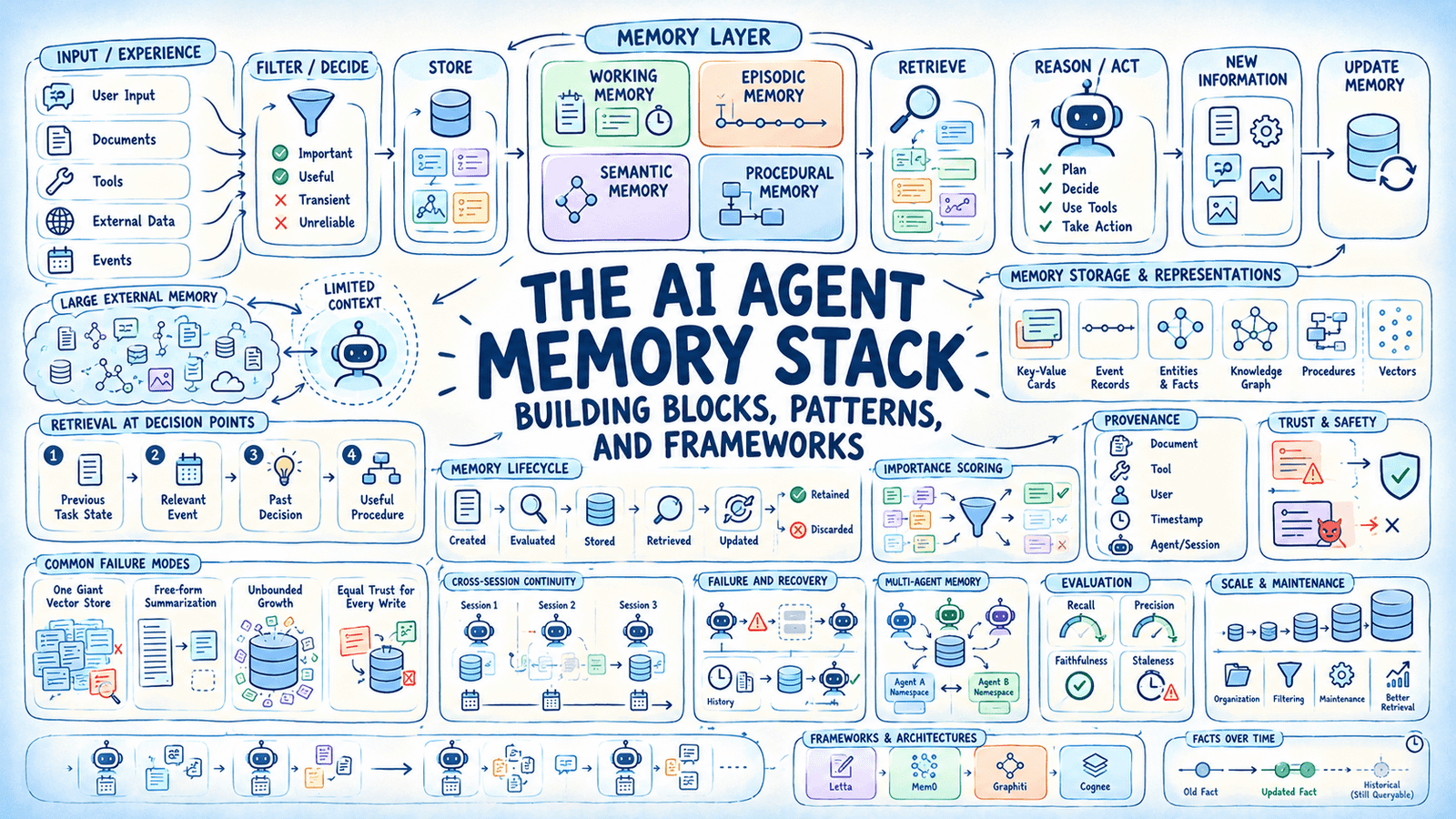

On this article, you’ll find out how agent reminiscence works, what forms of reminiscence exist, and the way completely different frameworks method storage, retrieval, and reminiscence administration at scale.
Subjects we are going to cowl embody:
- The core reminiscence sorts utilized in AI brokers and what each is designed to retailer.
- Sensible design methods for writing, retrieving, and sustaining agent reminiscence reliably.
- How main reminiscence frameworks differ of their storage fashions, retrieval approaches, and dealing with of reality modifications over time.
Introduction
A language mannequin doesn’t retain info between calls. Every time it runs, it really works with the textual content offered in that request and doesn’t routinely bear in mind what occurred earlier than. This works nicely for easy, one-off questions, however AI brokers want extra after they have to trace earlier actions, bear in mind consumer preferences, or proceed a activity throughout a number of steps.
Reminiscence solves this by storing info outdoors the mannequin’s context window and making it out there when wanted. However agent reminiscence isn’t a single mechanism. Various kinds of reminiscence serve completely different functions, whereas completely different storage and retrieval patterns have an effect on how reliably that info can be utilized. This text covers:
- The constructing blocks: what reminiscence sorts exist and what each is for
- How brokers retailer, retrieve, and replace info reliably
- How completely different frameworks deal with reminiscence storage, retrieval, and group
We begin with the constructing blocks.
The Constructing Blocks of Agent Reminiscence
Earlier than reminiscence frameworks and implementation patterns, it helps to outline what agent reminiscence must retailer. Completely different duties require completely different sorts of knowledge, and every sort of reminiscence has its personal position, storage mannequin, and retrieval technique.
Why Brokers Want Reminiscence at All
Brokers typically want to hold info throughout calls and duties. They might want to recollect what has already been scheduled to keep away from duplicate actions, retain a consumer’s preferences throughout periods, or carry ahead info found throughout a multi-step activity. They might additionally want to recollect failed approaches so they don’t repeat the identical work.
With out reminiscence, every name begins with solely the knowledge in its present context. The agent has no dependable strategy to know what occurred earlier than or what it has already discovered.
Agent Reminiscence Varieties
Agent reminiscence falls into the next sorts, every suited to a distinct sort of info and retrieval sample.
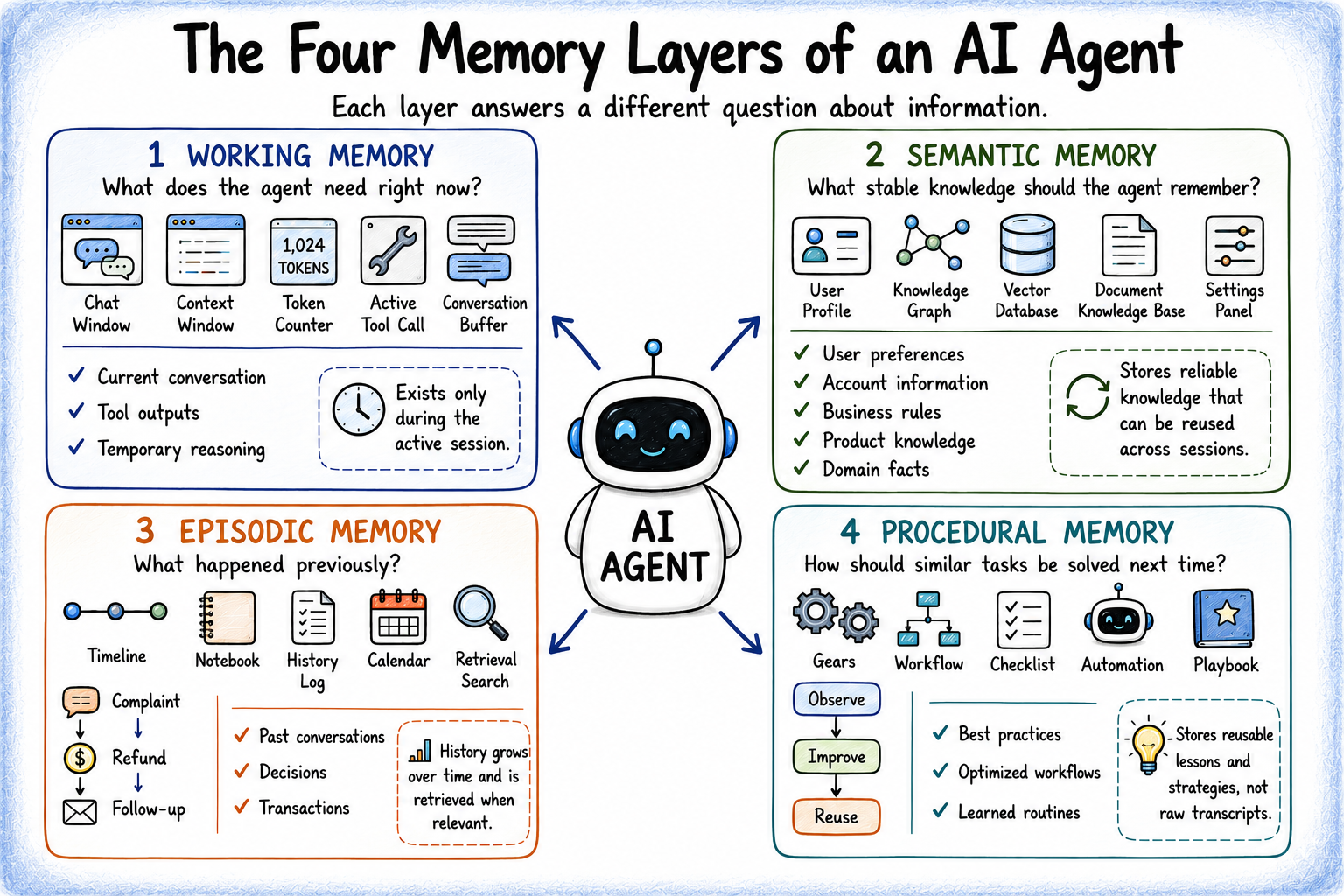
The desk under reveals what every reminiscence sort holds, the place it’s sometimes saved, and the way it’s retrieved:
| Reminiscence Sort | What It Holds | Storage Layer | Retrieval Methodology |
|---|---|---|---|
| Working | Energetic activity state: intermediate outcomes, scratchpad values | In-memory or short-lived key-value retailer | Direct lookup by key |
| Episodic | What occurred: previous interactions, activity runs, selections made | Time-ordered log or vector retailer | Semantic similarity search |
| Semantic | What’s true: details and preferences that get up to date fairly than appended | Key-value or entity retailer | Actual lookup by attribute, generally mixed with semantic search |
| Procedural | do issues: profitable motion patterns, recognized failure modes | Immediate templates or fine-tuning | Sample match or direct injection |
Working reminiscence is the knowledge at the moment out there within the context window. The opposite reminiscence sorts decide what info must be introduced into that context. Episodic reminiscence captures previous occasions, whereas semantic reminiscence shops details about entities, customers, or the setting. Maintaining these distinctions clear makes reminiscence simpler to retailer, retrieve, and keep.
Agent Reminiscence Design Methods
Understanding the completely different reminiscence sorts is barely the place to begin. The extra substantial half is deciding what must be saved, when it must be written, how lengthy it ought to stay, and when it must be retrieved. These selections decide whether or not reminiscence stays helpful as an agent runs longer duties and accumulates extra info.
A Labored Instance: A Multi-Step Analysis Agent
Take into account a analysis agent engaged on a activity over a number of days: gathering sources, extracting claims, drafting sections, and repeating the method.
After every step, the agent writes the consequence to working reminiscence with a brief expiry. Every entry is tagged with primary metadata, such because the device that produced it and the session it belongs to. When a consequence proves helpful, it may be promoted to episodic reminiscence with an significance rating. A short lived remark could also be discarded, whereas a choice that impacts later steps will be retained.
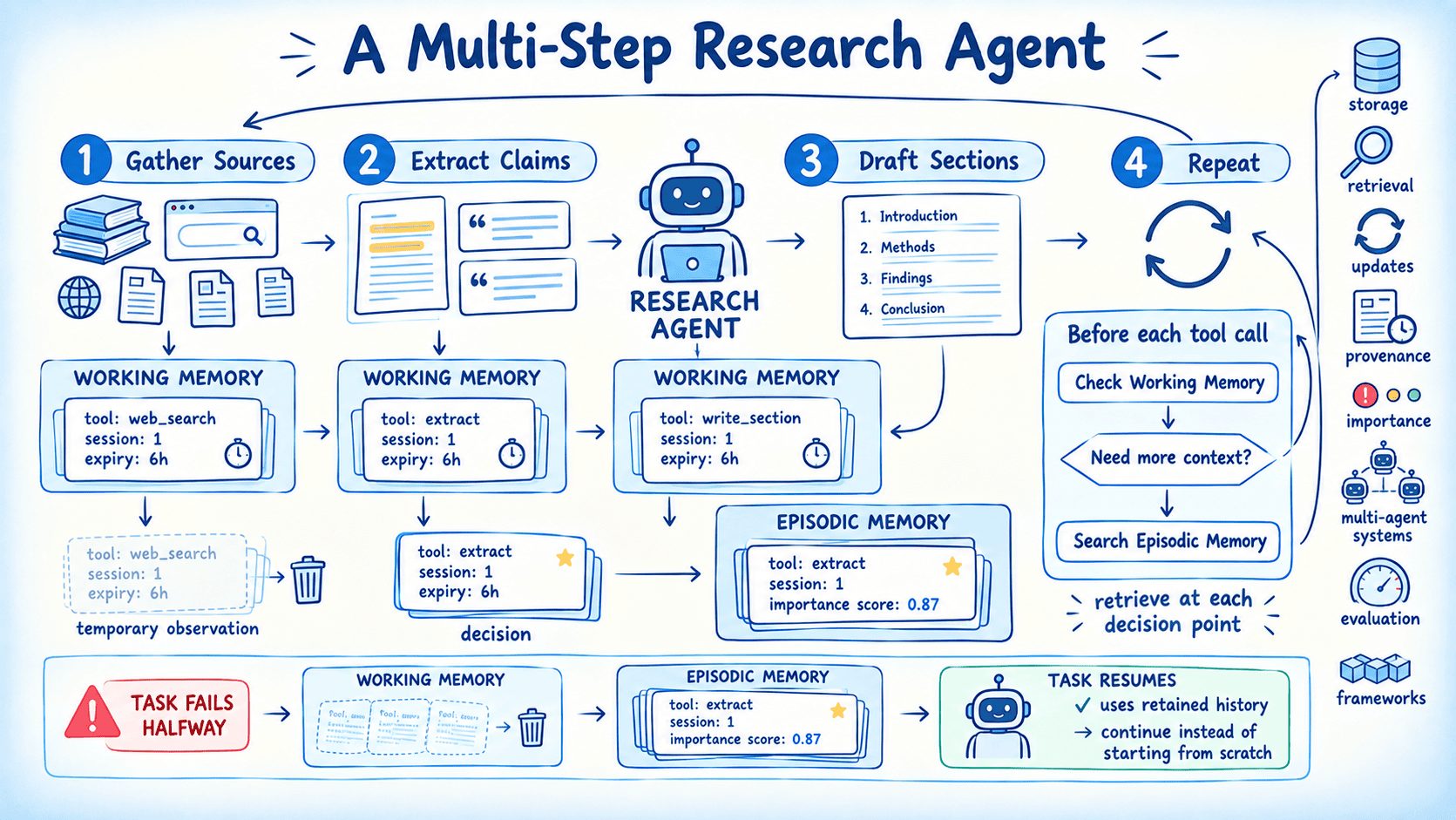
Earlier than every device name, the agent checks working reminiscence for related state after which searches episodic reminiscence when extra context is required. Retrieval occurs at every resolution level fairly than solely as soon as initially, as a result of the knowledge that issues can change as the duty progresses.
If the duty fails midway by, the agent can discard the momentary working state whereas retaining the episodic document of accomplished work. When the duty resumes, it might use that historical past as an alternative of ranging from scratch.
Reminiscence Design Methods That Work
A number of practices persistently make reminiscence methods extra dependable as they develop:
- Rating reminiscence significance earlier than writing: Filter out transient observations and low-value device outputs so the shop stays targeted on info that’s prone to matter later.
- Scope reminiscence by agent position: In multi-agent methods, maintain every agent’s reminiscence targeted on its tasks to scale back irrelevant or conflicting info.
- Retrieve at resolution factors: Refresh context all through a workflow as an alternative of retrieving reminiscence solely when the duty begins.
- Observe provenance: Document the place every reminiscence got here from, such because the agent, device, consumer enter, or timestamp. This makes reminiscence simpler to debug and audit.
Collectively, these practices assist maintain reminiscence related as duties grow to be longer and the quantity of saved info will increase.
Reminiscence Design Methods That Don’t At all times Work
Some approaches are easy to implement however grow to be unreliable because the reminiscence retailer grows. The desk under covers frequent approaches and the issues they introduce:
| Strategy | Why It Fails |
|---|---|
| Embedding all the things into one vector retailer | Retrieves info that’s semantically comparable however not essentially related to the duty, whereas making relationships between details troublesome to characterize. |
| Free-form summarization as reminiscence compression | Can take away particular particulars, constraints, or numbers that grow to be necessary later, and will protect an incorrect assertion as if it have been verified. |
| Unbounded reminiscence progress with no upkeep | Causes irrelevant entries to compete with helpful ones, lowering retrieval high quality whereas growing storage and upkeep prices. |
| Trusting each write equally | Creates a danger of reminiscence poisoning, the place untrusted or adversarial content material is saved and later handled as dependable info. |
The frequent drawback is treating reminiscence as one undifferentiated retailer. Dependable methods as an alternative separate reminiscence by function, apply completely different retrieval guidelines, and observe how a lot every saved merchandise must be trusted.
We’ve a extra detailed AI Agent Reminiscence Design: What Works and What Doesn’t article you may try if you’re .
Reminiscence Frameworks and Structure at Scale
The patterns above are implementation-agnostic. In follow, they’re constructed on high of reminiscence frameworks that make completely different decisions about storage, retrieval, construction, and upkeep.
⚠️ The frameworks talked about on this part should not an exhaustive record of all the things out there. As an alternative, they supply a helpful overview of a number of necessary approaches to agent reminiscence and the tradeoffs behind them.
For a broader have a look at the agent reminiscence framework panorama, see our agent reminiscence frameworks round-up.
How Reminiscence Frameworks Differ
These frameworks sit at completely different factors between flat, text-based reminiscence and structured data graphs. That alternative impacts how associated details are retrieved, how relationships are represented, and the way modifications to saved info are dealt with.
| Framework | Reminiscence Mannequin | Handles Truth Modifications By |
|---|---|---|
| Letta | Self-editing textual content blocks that the agent can rewrite straight | The mannequin identifies a contradiction and updates the block |
| Mem0 | Vector-based reminiscence with entity-aware retrieval | New reminiscences are added and retrieved alongside current ones |
| Graphiti | Bi-temporal data graph with typed relationships between entities | Invalidating older relationships whereas conserving their historical past queryable |
| Cognee | Extraction pipeline that builds graph, vector, and relational layers from supply information | Rebuilding the reminiscence illustration, with temporal modes for monitoring modifications |
If you’re curious about going deeper into how completely different frameworks method storage, retrieval, and reminiscence administration, try Agent Reminiscence Methods and Information Graphs: Letta, Mem0, Graphiti, and Cognee.
Frameworks differ primarily in how they set up saved info, characterize relationships between details, and deal with modifications over time. An easier reminiscence layer can work nicely when an agent primarily must retrieve related details or current context. Extra structured methods grow to be helpful when the agent must comply with relationships between entities, motive throughout a number of details, or protect how info modified over time.
Multi-Agent Reminiscence and Analysis
As reminiscence methods grow to be extra advanced, two considerations grow to be more and more necessary: how a number of brokers share and replace reminiscence, and the way you measure whether or not the reminiscence system is definitely working.
- Shared reminiscence: When a number of brokers learn and write the identical reminiscence, concurrent updates can create conflicts. Widespread approaches embody a central reminiscence service with write controls, separate namespaces for every agent, or append-only logs with conflicts resolved throughout retrieval.
- Retrieval recall: Measures whether or not related reminiscences are retrieved after they exist.
- Retrieval precision: Measures how a lot irrelevant info is returned alongside related reminiscences.
- Faithfulness: Checks whether or not the agent truly makes use of retrieved info accurately in its reasoning.
- Staleness: Measures how typically the system retrieves info that’s not present.
These metrics and design decisions grow to be more and more necessary as reminiscence shops develop, duties run for longer, and a number of brokers share the identical info. You can too learn Why Multi-Agent Methods Want Reminiscence Engineering on the MongoDB weblog, or work by a course like Constructing Reminiscence-Conscious Brokers on DeepLearning.AI to study extra.
Abstract
Agent reminiscence is an architectural layer that determines how an agent carries info throughout calls, duties, and periods. Designing it requires clear selections about storage, retrieval, updates, and lifecycle administration.
This text coated the primary reminiscence sorts, sensible design patterns, frequent failure modes, and the architectural tradeoffs throughout completely different reminiscence frameworks. It additionally regarded on the challenges of longer-running and multi-agent methods, together with analysis, consistency, and upkeep.
The suitable method is determined by the agent’s workload, information, and operational necessities. For those who need assistance selecting an method for a particular use case, learn Selecting the Proper AI Agent Reminiscence Technique: A Resolution-Tree Strategy.