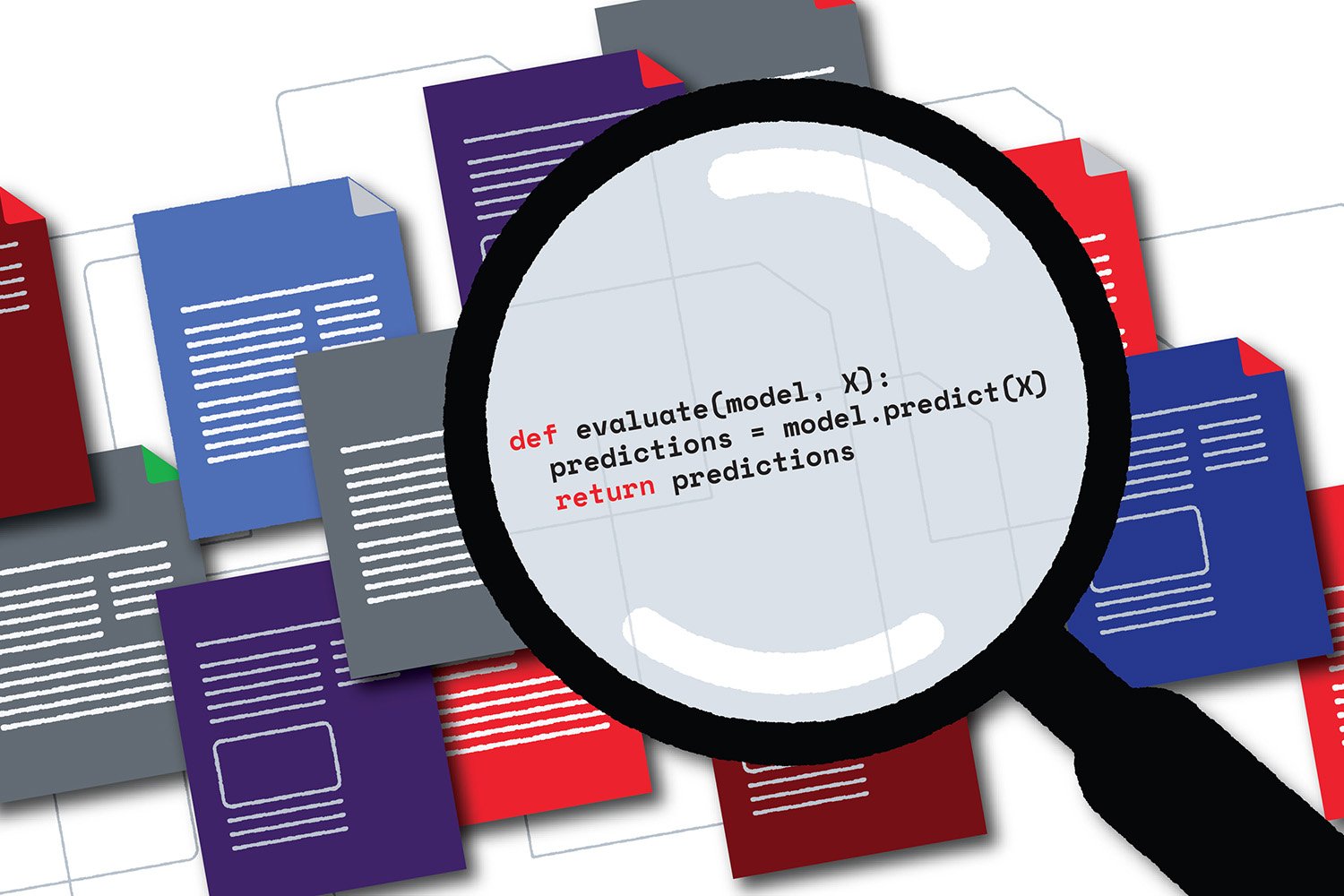

The info and code that underpin a analysis examine can inform us what was really achieved, and the way. In a medical examine, for instance, how had been sufferers chosen for inclusion? How had been lacking values dealt with? How had been the outcomes evaluated?
Entry to a examine’s information and code assist researchers to reply these questions, to look at the strategies, and to construct on the work.
“Research contain many decisions about methods to put together information, develop fashions, and consider efficiency. These are generally known as ‘researcher levels of freedom,’” says Tom Pollard, a analysis scientist at MIT’s Laboratory for Computational Physiology and Laptop Science and Synthetic Intelligence Laboratory. “The alternatives we make have an effect on the outcomes, and a strategies part in a paper can solely seize a lot element.”
Whereas sharing code generally is a first step, to ensure that code to be understood and reused, it should be sufficiently structured and described. The issue is that, proper now, there’s little steerage for researchers on what constitutes a well-organized, well-described assortment of code.
That is the place a global group led by researchers at MIT and Dana-Farber Most cancers Institute sought to assist, by analyzing how code is presently shared in scientific prediction research. Such research develop or consider fashions to estimate affected person outcomes, akin to the danger of growing a illness. As a result of these fashions inform choices about affected person care, researchers want to have the ability to scrutinize how they had been constructed and examined.
Utilizing massive language fashions (LLMs), the researchers examined practically 4,000 papers to determine statements about shared code. They then adopted the statements to evaluate a whole bunch of related code repositories.
Their evaluation revealed two key gaps: Code sharing stays unusual, and making code public doesn’t constantly imply offering the documentation and supporting info wanted for reuse. The open-access findings, not too long ago revealed in Nature Drugs, are informing TRIPOD-Code, a reporting guideline being developed to make clear what researchers ought to share.
Following the code
TRIPOD-Code builds on TRIPOD and TRIPOD+AI, checklists that assist researchers report how scientific prediction fashions had been developed and evaluated. To know present code-sharing practices, the group recognized research citing both guideline. The evaluation included virtually 4,000 research that developed, up to date, or validated prediction fashions, and whose full texts had been out there via PubMed Central’s open-access assortment.
“The problem was that the data was extremely inconsistent. First, we needed to determine whether or not or not a paper shared code” says Thomas Sounack, the examine’s first writer. He provides that authors “focus on and hyperlink to code from a paper in many alternative methods.”
The group used an LLM to assist display papers, determine statements about code availability, and extract hyperlinks. Software program then retrieved the linked repositories — on-line collections of code and associated information — for additional evaluation.
The workflow went past checking whether or not a hyperlink existed. It additionally assessed repositories in opposition to traits akin to completeness of documentation, software program necessities, and phrases of reuse.
“The true advantage of LLMs is their capability to course of unstructured info akin to textual content. These fashions helped us work with info that was scattered throughout papers and software program repositories, moderately than neatly organized in a desk,” says Pollard, who’s a senior writer of the examine. “That allowed us to look at how code was being shared in rather more element throughout a big assortment of research.”
Human reviewers evaluated the work of the LLMs. Two researchers independently checked 500 papers and a separate pattern of repositories, resolving disagreements earlier than evaluating their assessments with the automated outcomes.
Settlement was stronger for concrete traits, akin to whether or not a license file was current, than for judgments concerning the adequacy of documentation. As a result of classification errors stay doable, the authors emphasize the general patterns moderately than treating each rely as actual.
Inconsistent code sharing
Solely about 1 in 8 research reported sharing code. The place code was shared, the contents of repositories diverse broadly.
Some repositories had been “extraordinarily well-organized and -documented, whereas others gave virtually no steerage in any respect,” Sounack says. Good code sharing, he explains, means “giving sufficient info to grasp what the code does and be capable to run it to breed the outcomes reported within the paper.”
Practices additionally diverse considerably throughout journals and nations. Amongst journals, the proportion of research sharing code ranged from zero to greater than 70 %. Some journals with low sharing charges nonetheless had written code-sharing insurance policies, suggesting that insurance policies alone is probably not sufficient to encourage code sharing.
The evaluation additionally helped to determine examples of efficient observe. Some researchers, for instance, offered artificial datasets to help with code reuse the place the unique affected person information couldn’t be shared publicly.
Setting an ordinary for code sharing
Researchers who share code are already making an effort to make their work clear. However scientific prediction analysis brings collectively individuals from medication, statistics, and pc science, whose expectations for documenting and sharing code could differ.
TRIPOD-Code goals to determine a consensus. By way of an skilled evaluation course of, the group is growing steerage on which components of shared analytical code ought to be thought of important.
“We wish to give researchers sensible steerage on methods to share code, and provides journals clearer expectations to speak to authors,” Pollard says. “The evaluation provides us proof to tell these discussions.”