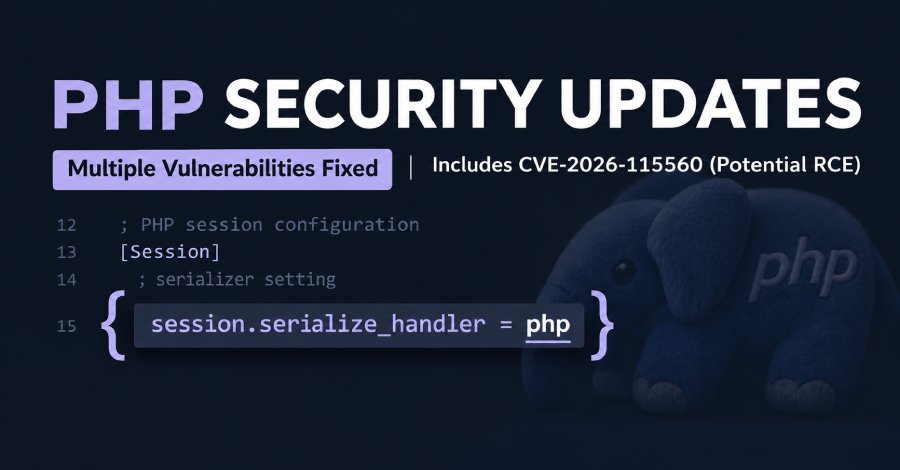


The PHP Basis has launched safety updates to handle a number of important safety flaws that could possibly be exploited to attain distant code execution on affected deployments, together with CVE-2026-115560.
The discharge of the patch follows an advance discover wherein the venture maintainers alerted customers to a number of important vulnerabilities affecting all supported PHP variations below particular circumstances, together with non-default configuration or unusual setups.
At a excessive stage, profitable exploitation of the defects might pave the best way for distant code execution, session corruption, denial-of-service, reminiscence corruption, or native privilege escalation.
The listing of vulnerabilities is as follows –
- CVE-2026-115560 (CVSS rating: 9.2) – An improper enter validation vulnerability that might lead to distant code execution, file modification, session corruption, or denial-of-service. (Fastened in PHP 8.2.36, 8.3.37, 8.4.28, 8.5.13, 8.6.0)
- CVE-2026-129182 (CVSS rating: 9.2) – A use-after-free vulnerability that might lead to reminiscence corruption and potential full distant code execution, as within the case of CVE-2026-109619. (Fastened in PHP 8.5.13, 8.6.0)
- CVE-2026-126714 (CVSS rating: 9.2) – A Time-of-check Time-of-use (TOCTOU) vulnerability that might consequence within the execution of arbitrary code with the privileges of the PHP employee. Profitable exploitation requires an attacker’s affect over the session knowledge, an interruption at a helpful level within the write, and an utility with an acceptable deserialization gadget chain. (Fastened in PHP 8.2.36, 8.3.37, 8.4.28, 8.5.13, 8.6.0)
- CVE-2026-129289 (CVSS rating: 9.2) – An inconsistent interpretation of HTTP requests vulnerability that might lead to execution of attacker-controlled PHP code because the employee with out one other consumer’s interplay or a non-default PHP configuration. Profitable exploitation requires a entrance finish that allows persistent backend connections and an utility path that opens “php://enter” with out studying it absolutely, akin to nginx with fastcgi_keep_conn on, Apache mod_proxy_fcgi with enablereuse=on, HAProxy FastCGI purposes that retain backend connections, and LSAPI. (Fastened in PHP 8.2.36, 8.3.37, 8.4.28, 8.5.13, 8.6.0)
- CVE-2026-129474 (CVSS rating: 9.2) – A use-after-free vulnerability that might lead to distant code execution on PHP 8.5 and later. Profitable exploitation is dependent upon the appliance and requires management over sufficient request knowledge to affect reminiscence allocation, a reachable magic technique name, and a deadly error on the related level. (Fastened in PHP 8.5.13, 8.6.0)
- CVE-2026-129481 (CVSS rating: 9.2) – A use-after-free vulnerability that might trigger an utility’s session cleanup to fail and probably corrupt reminiscence, crash a reused PHP employee, or probably permit distant code execution. (Fastened in PHP 8.3.37, 8.4.28, 8.5.13, 8.6.0)
- CVE-2026-129496 (CVSS rating: 9.2) – A use-after-free vulnerability that might permit an unauthenticated distant attacker to crash PHP employees or execute arbitrary code with their privileges on an affected deployment. (Fastened in PHP 8.2.36, 8.3.37, 8.4.28, 8.5.13, 8.6.0)
- CVE-2026-129291 (CVSS rating: 8.8) – A use-after-free vulnerability that might lead to native privilege escalation. Profitable exploitation requires native code execution in an FPM employee, an affected pool with catch_workers_output enabled, the epoll occasion backend, and the power to govern employee lifetimes and retain inherited pipe descriptors. (Fastened in PHP 8.2.36, 8.3.37, 8.4.28, 8.5.13, 8.6.0)
Depthfirst, which has codenamed CVE-2026-126714 “phpAfterShell,” has described it as a important flaw that may allow a distant attacker to run arbitrary code on affected servers.

“If a pwrite()/ftruncate() replace is interrupted, PHP might depart behind a malformed session file that’s later loaded by session_start(), yielding an arbitrary deserialization primitive,” Depthfirst stated. “Chained with one other of our PHP-native deserialization-to-RCE findings, this leads on to distant code execution.”
Put in another way, the vulnerability turns an interrupted file write into a possible distant code execution primitive by manipulating how PHP writes session knowledge to disk, inflicting it to interpret beforehand innocent knowledge as executable object knowledge.
It then exploits the surprising session state the place the PHP employee both dies whereas the write course of is underway, leaving {a partially} up to date file, or dies after the write is full, however earlier than content material from the earlier session is eliminated. Each situations result in a mix of two completely different session states.
“Relying on the place the interruption occurs, a part of the brand new Session might have already got been written whereas bytes from the earlier Session stay on disk,” safety researcher Yuhang Wu stated. “The consequence could be a Session file containing the prefix of the brand new serialized knowledge and the tail of the outdated one.”
“By fastidiously selecting the size fields within the new prefix, an attacker could make PHP’s Session decoder interpret leftover bytes that have been beforehand simply a part of an abnormal string as separate Session entries and serialized objects. Nothing must be deserialized through the upload-progress callback itself. The attacker solely wants to depart the correct bytes on disk and look forward to the appliance to name session_start(), at which level PHP reads the modified Session and deserializes these objects.”
As soon as the prefix of 1 legitimate session is spliced with the tail of a substitute session, a subsequent session treats the corrupted knowledge as a reliable server-side state. This, in flip, causes PHP to interpret it as a “completely different, legitimate Session” and finally allow distant code execution by chaining it with a memory-corruption in a PHP-native class.
It impacts any utility that runs an affected PHP model with file-based periods. If quick patching shouldn’t be potential, it is suggested to show off session add progress.
Patches for the failings can be found within the following variations –
- PHP 8.2.36
- PHP 8.3.37
- PHP 8.4.28
- PHP 8.5.13
- PHP 8.6.0
Customers who’re utilizing present 8.2.x, 8.3.x, 8.4.x, and eight.5.x variations of PHP are suggested to replace to the newest model for optimum safety.