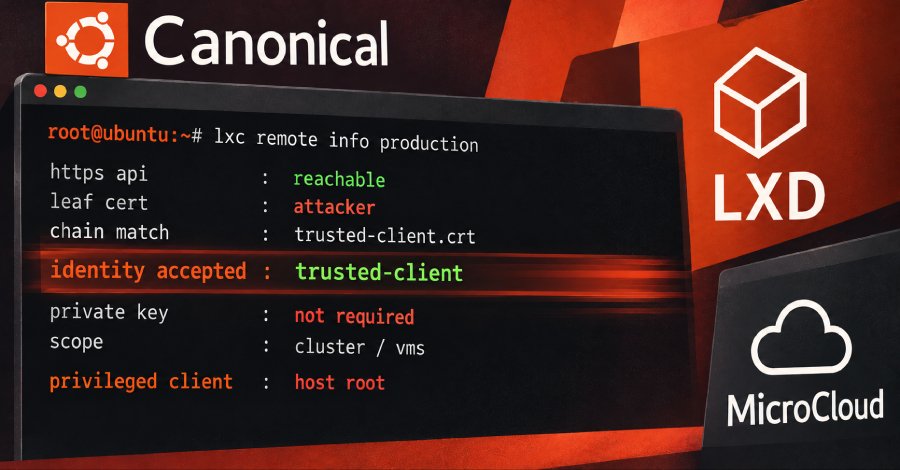


A vital flaw in Canonical’s LXD and MicroCloud let an attacker log in as a trusted consumer with out holding that consumer’s non-public key. To do it, the attacker needed to attain their HTTPS API over the community and have the trusted consumer’s public certificates.
As soon as in, the attacker would act as that consumer, with entry to the cluster and its digital machines. If the impersonated account is privileged, the attacker may achieve “root entry to the host machine,” Canonical mentioned.
The flaw, tracked as CVE-2026-112816, carries a most CVSS rating of 10.0, and Canonical has launched fastened variations of each merchandise.
How the Flaw Works
LXD and MicroCloud let distant shoppers entry their APIs over mutual TLS, a setup wherein the consumer presents a certificates to show who it’s. A consumer is trusted when its certificates is within the server’s belief retailer, the listing of identities the server will settle for.
The flaw was in how the server checked that certificates. It in contrast each certificates the consumer despatched in opposition to the belief retailer, however a TLS connection solely proves the consumer owns the non-public key for the primary certificates within the chain, the leaf. The remainder of the chain is regardless of the consumer selected to connect.
So an attacker may take a trusted consumer’s public certificates, which isn’t secret, connect it to the chain behind their very own, and the server would settle for them as that consumer.
Who Is Affected
Utilizing the flaw takes two issues: community entry to the HTTPS API, and the general public certificates of a consumer the server already trusts.
A standalone LXD server doesn’t expose that API by default. It listens solely on an area socket until an administrator activates the community API with the core.https_address setting.
MicroCloud, which ties a number of machines working LXD into one cluster, has a selected weak level. Canonical mentioned an attacker who can seize a member’s public certificates because it joins the cluster can then log in as that member.
The CVE report lists LXD 4.0.14, 5.0.10, 5.21.8 and 6.9 as affected, every earlier than the fastened launch that follows. Canonical lists these fastened snap variations:
| Product | Snap channel | Fastened model |
|---|---|---|
| LXD | 6/secure | 6.10.1 |
| LXD | 5.21/secure | 5.21.9 |
| LXD | 5.0/secure | 5.0.11 |
| LXD | 4.0/secure | 4.0.15 |
| MicroCloud | 3/secure | 3.4.1 |
| MicroCloud | 2/secure | 2.1.5 |
The bug didn’t begin at Canonical. The Incus mission, which started as a group fork of LXD, reported it, and Canonical confirmed it affected LXD as properly. Incus fastened the identical flaw in model 7.6.0.
Ubuntu’s personal archive packages of LXD are listed as not affected or not shipped, so the fastened releases are the snaps.
There isn’t a public signal the flaw has been utilized in an assault. The CVE report carries a U.S. CISA evaluation, dated October 30, that the flaw shouldn’t be recognized to have been exploited; it isn’t on CISA’s Recognized Exploited Vulnerabilities listing, and no working exploit has been revealed.
What to Do
Replace LXD and MicroCloud to the fastened variations. On a snap set up, run sudo snap refresh lxd and sudo snap refresh microcloud.
Canonical mentioned the fastened LXD level releases have been nonetheless rolling out from the candidate channel to secure on the time of its advisory, so test the model you even have after the refresh reasonably than assume the repair arrived.
Canonical’s advisory provides no non permanent workaround for LXD. As a result of the assault requires community entry to the API, limiting who can attain it reduces danger till you replace. The Incus mission, reporting the identical flaw, mentioned there is no such thing as a configuration repair and that the one step is to limit community entry to the listener.
Incus customers ought to transfer to 7.6.0, which fastened this flaw together with 17 different safety points.